
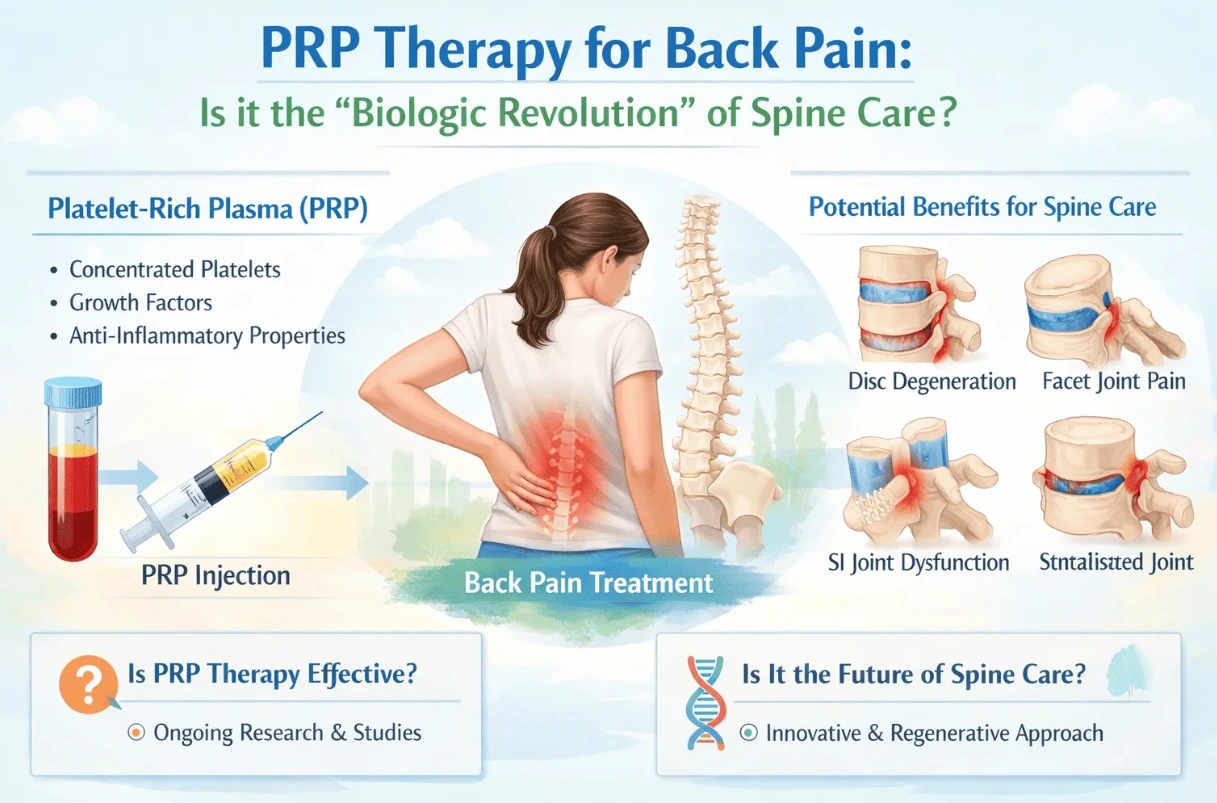
During my review of emerging non-surgical approaches to spine care, PRP for back pain stood out as a treatment being explored for selected patients with chronic pain related to degenerative discs and facet joints. Platelet-rich plasma, or PRP, uses a concentrated portion of the patient’s own blood, containing platelets and growth factors, which are intended to support the body’s natural healing response. At Synapse Spine, PRP is described as a potential option for patients with degenerative disc disease or chronic facet joint pain who have not obtained adequate relief with conservative treatment.
Importantly, PRP should not be considered a universal cure for back pain. Its suitability depends on the underlying diagnosis, severity of degeneration, symptoms and clinical assessment.
What Is PRP Therapy for Back Pain?
PRP therapy begins with drawing a small quantity of the patient’s blood. The blood is processed to concentrate platelets, after which the prepared PRP is injected into the targeted area.
Platelets are naturally involved in tissue repair. They contain growth factors and other signalling substances involved in healing and inflammation. The concept behind PRP treatment is to concentrate these components and deliver them to a specific area that may benefit from a healing response.
Unlike a conventional steroid injection, PRP uses material derived from the patient’s own blood. This makes it a biologically based treatment rather than an injection of a pharmaceutical steroid.
PRP for Back Pain: How Could It Help?
The potential role of PRP for back pain is being investigated particularly in conditions involving degenerative discs and facet joint pain.
Chronic spinal pain can develop when discs, joints or surrounding tissues undergo degeneration. In some patients, persistent inflammation may contribute to symptoms even when surgery is not immediately necessary.
PRP is intended to influence the local biological environment through concentrated platelets and growth factors. The goal is not simply to temporarily mask pain but potentially to support tissue healing and reduce inflammation.
However, results can vary significantly between patients. PRP cannot reverse every type of spinal degeneration, and it is not an alternative to surgery when there is a serious structural problem requiring operative treatment.
Potential Benefits of PRP
Depending on the underlying condition and patient selection, potential advantages may include:
- Use of the patient’s own blood-derived components
- A minimally invasive approach
- No surgical incision
- Potential reduction in chronic pain
- A possible option when physiotherapy and other conservative measures have not provided sufficient relief
- Potentially avoiding or delaying surgery in appropriately selected cases
The Synapse Spine reference article describes PRP as occupying a potential treatment space between unsuccessful physiotherapy and patients who are not ready for surgery.
Who May Be a Candidate for PRP?
Not everyone with back pain is an appropriate candidate. A detailed evaluation is necessary before considering injection-based regenerative treatments.
According to the Synapse Spine reference material, PRP is used for selected patients with degenerative disc disease or chronic facet joint pain.
A spine specialist may assess:
- The duration and severity of symptoms
- Whether pain originates from the disc, facet joint, nerve or another structure
- MRI or other imaging findings when indicated
- Previous physiotherapy or medication response
- Neurological symptoms
- General health and medical history
- Whether surgery or another intervention would be more appropriate
This diagnostic process is important because “back pain” is not a single disease. Muscle strain, disc herniation, spinal stenosis, facet arthritis, inflammatory disorders and other conditions can produce overlapping symptoms but require different treatments.
How Is the Procedure Performed?
PRP treatment generally involves collecting blood and processing it to concentrate platelets. The prepared material is then delivered to the selected spinal structure.
At Synapse Spine, the reference article notes that the injection is performed under local anaesthesia, making the procedure relatively comfortable for many patients.
The exact injection technique depends on the suspected pain generator and the treatment plan. Careful targeting is particularly important when treating structures close to the spine.
Following the procedure, patients may receive specific activity and rehabilitation instructions. The objective is to gradually return to normal function rather than immediately resume strenuous physical activity.
How Long Does PRP Take to Work?
One important difference between PRP and some conventional pain-relieving injections is the expected timeline.
Steroid injections can sometimes provide relatively rapid symptom relief, whereas PRP is intended to produce a biological response that may take longer. The Synapse Spine article states that patients may require approximately 4–6 weeks for growth factors to exert their intended effects.
Some patients may experience improvement after one treatment, while others may require additional assessment or a subsequent injection. The reference article notes that a second booster injection may sometimes be considered three to six months later, depending on the degree of disc or joint degeneration.
PRP vs Steroid Injections
Both PRP and steroid injections may be considered in non-surgical spine care, but their intended mechanisms are different.
Steroids primarily target inflammation and can provide relatively rapid symptom relief. PRP instead uses concentrated platelets from the patient’s own blood and is intended to support the biological healing environment.
This does not mean PRP is automatically “better” than steroids. The appropriate treatment depends on the patient’s diagnosis, goals and clinical circumstances. A specialist should explain the potential benefits, limitations and alternatives before treatment.
Risks and Limitations
Although PRP uses the patient’s own blood, it is still an injection procedure and is not completely risk-free.
Possible issues can include temporary pain or soreness at the injection site, bleeding, infection and failure to achieve meaningful symptom improvement. The overall risk profile also depends on where and how the injection is performed.
Patients should also understand that PRP cannot guarantee tissue regeneration or eliminate the need for surgery in patients with significant structural spinal disease.
For this reason, treatment should be based on an accurate diagnosis rather than simply choosing PRP because it is marketed as a regenerative therapy.
Synapse Spine Surgeons: Qualifications and Clinical Expertise
The Synapse Spine surgeons team includes specialists from orthopaedic spine surgery and neurosurgery backgrounds. The current team includes orthopaedic spine surgeons, neurospine surgeons, a brain and spine surgeon, a neurosurgeon and a consultant spine surgeon and pain-management specialist.
Among the senior specialists, Dr. Nandan Marathe is an orthopaedic spine surgeon with MBBS and MS Orthopaedics qualifications from Seth GS Medical College and KEM Hospital. He has undertaken fellowships and advanced training in complex spine surgery and deformity at the University of Toronto, spinal tumours in Italy, and minimally invasive spine surgery in Korea. His profile also reports more than 146 peer-reviewed publications.
Dr. Anuj Bhide is a Brain & Spine Surgeon with MBBS, MS General Surgery and MCh Neurosurgery qualifications. He is a Gold Medalist from Grant Medical College and JJ Hospitals and completed a fellowship in skull-base and vascular surgery at Fujita Health University, Japan. His profile reports more than nine years of experience as a consultant brain and spine surgeon in Mumbai.
Together, the team brings expertise across minimally invasive spine surgery, complex spinal disorders, neurosurgery, deformity correction, spinal tumours and pain management.
Clinic Environment and Patient-Centred Spine Care
Synapse Spine operates through multiple clinic locations across Mumbai and the surrounding metropolitan region, including Bandra, Andheri, Vile Parle, Borivali, Mira Road, Vasai and Virar. The organisation describes its approach as combining modern technology, clinical expertise and patient-centred care.
For someone searching for a Top Spine Specialist in Mumbai, India, the value of a multidisciplinary spine team is that treatment can be matched to the actual cause of pain rather than relying on a single procedure.
The approach includes both non-surgical and surgical options, ranging from physiotherapy and spinal injections to minimally invasive and endoscopic spine procedures.
When Should You Consider PRP?
Persistent back pain deserves a proper diagnosis before any injection is considered. If symptoms continue despite appropriate conservative treatment, a spine consultation can help determine whether PRP, physiotherapy, medication, another injection, or surgery is appropriate.
PRP may be particularly relevant for carefully selected patients with chronic degenerative disc or facet-related pain, but expectations should remain realistic. The treatment is not a “magic wand,” and outcomes differ between individuals.
Book a Consultation at Synapse Spine
If you are experiencing persistent back pain and want to understand whether PRP or another non-surgical treatment could be appropriate, consult the Synapse Spine surgeons for an individual assessment.
📞 +91 81698 45056 | +91 93726 71858 | +91 93211 24611
📧 synapsespine@gmail.com
Get Directions to the Clinic – Synapse Spine, Mumbai
FAQs
1. What is PRP for back pain?
PRP is a treatment in which platelets are concentrated from a patient’s own blood and injected into a targeted area. It is being used selectively for conditions such as degenerative disc disease and chronic facet joint pain.
2. How long does PRP take to work for back pain?
Improvement is generally not expected immediately. The Synapse Spine reference article indicates that biological effects may take around 4–6 weeks to develop, although individual responses vary.
3. Is PRP better than a steroid injection?
Neither treatment is universally better. Steroids may provide faster short-term relief, while PRP is intended to influence the biological healing environment. The appropriate option depends on the diagnosis and individual circumstances.
4. How many PRP injections are needed?
Some patients may improve after one session. Depending on the severity of disc or joint degeneration and the response to treatment, a further injection may sometimes be considered.