
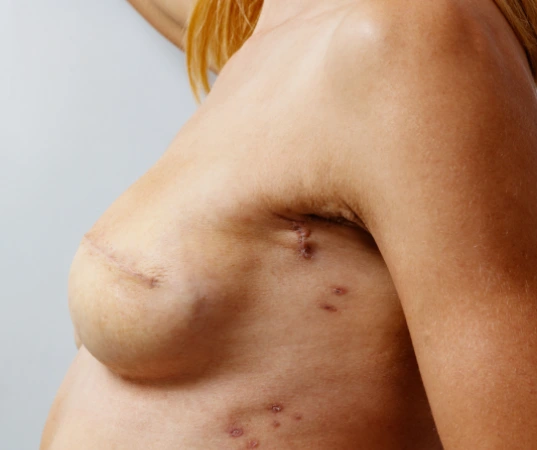
Breast cancer treatment can bring physical and emotional changes that continue long after surgery. For women who have undergone mastectomy or breast-conserving surgery, breast reconstruction may offer an option to restore breast shape and improve body symmetry. Breast reconstruction post cancer in Mumbai can be planned immediately during cancer surgery or later, depending on the cancer treatment, overall health, radiation therapy and individual preferences. Dr. Devayani Barve, a Plastic, Aesthetic & Reconstructive Surgeon at Jewel Aesthetic Centre, provides personalised breast reconstruction planning based on each patient’s anatomy, treatment history and expectations.
What Is Breast Reconstruction After Cancer?
Breast reconstruction is a surgical procedure that recreates the breast mound after tissue has been removed during cancer treatment. It may follow a complete mastectomy or, in selected cases, breast-conserving surgery when the breast contour has been significantly altered.
The objective is not simply to recreate breast volume. Reconstruction can also address symmetry, breast shape and the appearance of the chest after cancer treatment. The reconstruction page notes that the process can contribute to improved body image and emotional well-being for some women.
Every patient’s situation is different. Dr. Devayani Barve works in coordination with oncologists to determine an approach that considers the patient’s cancer treatment, anatomy and expectations.
Breast reconstruction post cancer in Mumbai: Available Techniques
There are three broad approaches to reconstruction described by Dr. Devayani Barve’s clinic:
1. Implant-Based Reconstruction
Implant-based reconstruction uses a silicone or saline implant to recreate the breast mound. An implant may be placed immediately after mastectomy or through a staged approach involving a tissue expander.
One advantage of implant-based reconstruction is that it is generally less extensive than flap surgery and may involve a shorter recovery period. Whether it is appropriate depends on factors including the patient’s tissue quality, previous treatment and reconstructive goals.
2. Autologous or Flap Reconstruction
Flap reconstruction uses the patient’s own tissue to create the breast. Tissue may be taken from areas such as the abdomen, back or thighs.
The techniques mentioned on Dr. Devayani Barve’s page include DIEP flap, TRAM flap and latissimus dorsi flap reconstruction. Autologous reconstruction can provide a more natural tissue feel, although it is generally a more involved operation than implant-based reconstruction.
3. Hybrid Reconstruction
A combination approach uses both an implant and the patient’s own tissue. This may be considered when combining the advantages of implant volume with additional tissue coverage or contouring. The final choice depends on individual anatomy and the patient’s cancer-treatment history.
Immediate vs Delayed Reconstruction
Reconstruction can broadly be classified as immediate or delayed.
Immediate reconstruction takes place during the mastectomy procedure. It may allow the breast mound to be reconstructed during the same surgical episode.
Delayed reconstruction takes place later—weeks, months or even years after mastectomy. This may be particularly relevant for women who require additional cancer treatment, including radiation therapy.
The appropriate timing should be decided in coordination with the treating oncology team. Dr. Devayani Barve evaluates factors such as cancer stage, treatment plan and the patient’s readiness before recommending a reconstruction timeline.
Reconstruction After Radiation Therapy
Radiation therapy can affect the quality and healing capacity of the skin. Therefore, previous radiation treatment is an important consideration during reconstructive planning.
Dr. Devayani Barve’s reference page notes that autologous tissue may be preferable to implants in some patients who have undergone radiation, although the decision must be individualised after assessing the skin and surrounding tissues.
This is one reason why consultation between the oncologist and reconstructive plastic surgeon can be important before surgery.
Restoring Breast Symmetry
When only one breast has been affected, reconstruction may be combined with procedures on the opposite breast to create better symmetry. Depending on the patient’s anatomy, the opposite breast may be resized, reshaped or lifted.
Symmetry does not necessarily mean that both breasts will be identical. The goal is generally to achieve a balanced appearance that suits the patient’s body.
Nipple and Areola Reconstruction
Nipple and areola reconstruction can be performed as a later stage of the reconstruction process. The clinic describes both surgical techniques and medical tattooing as possible options.
This stage can help complete the visual appearance of the reconstructed breast. However, patients should understand that sensation may not be identical to that of a natural breast. Full return of sensation is uncommon, although some nerve regeneration may occur with certain flap procedures.
Recovery, Sensation and Possible Risks
Recovery varies significantly depending on the reconstructive technique. The clinic’s FAQ describes an approximate recovery period of three to six weeks, although individual recovery can differ according to the procedure and the patient’s health.
Reconstructed breasts may have reduced sensation compared with natural breast tissue. Pain is generally expected to decrease during the weeks following surgery, but the experience differs between patients.
As with other major surgical procedures, breast reconstruction has potential risks. These can include infection, bleeding, problems related to implants and, rarely, flap failure. Patients should discuss the specific risks associated with their selected technique during consultation.
Dr. Devayani Barve: Qualifications and Clinical Experience
Dr. Devayani Barve is an internationally trained Plastic, Aesthetic & Reconstructive Surgeon. She completed her MBBS from KEM Hospital, Mumbai, in 2007, followed by an MS in General Surgery from KEM Hospital in 2010 and an MCh in Plastic Surgery from PGIMER, Chandigarh, in 2013. She also holds ECFMG certification in the USA and was an ASAPS International Fellow during 2016–2017.
Her advanced training includes an aesthetic and breast surgery fellowship with Dr. Onelio Garcia Jr. in Miami, the University of Miami’s VEST program and an international aesthetic fellowship with the American Society for Aesthetic Plastic Surgery. She also served as an Assistant Professor of Plastic Surgery at Christian Medical College, Vellore.
Her academic background includes publications in plastic and reconstructive surgery, while her professional memberships include the Association of Plastic Surgeons of India, Indian Association of Aesthetic Plastic Surgeons and Indian Medical Association.
For someone searching for a plastic surgeon in Mumbai, India, these qualifications and specialised breast-surgery training are relevant factors to consider when evaluating reconstructive care.
Clinic Environment and Reconstructive Expertise
Jewel Aesthetic Centre in Juhu, Mumbai, is the clinical setting associated with Dr. Devayani Barve’s practice. Her profile describes her as an internationally trained surgeon working across plastic, aesthetic and reconstructive surgery, with particular experience in breast and body procedures.
The breast reconstruction page emphasises an individualised approach, with treatment planning based on the patient’s cancer treatment, anatomy and expectations. Dr. Devayani Barve‘s expertise includes breast surgery and reconstructive procedures, supported by her advanced training in India and the United States.
For patients researching a Celebrity Plastic Surgeon in Mumbai, India, it remains important to look beyond recognition and consider formal qualifications, reconstructive training, surgical experience, hospital support and the surgeon’s ability to coordinate care with oncology specialists.
Is Breast Reconstruction Necessary?
No. Reconstruction is an elective choice for many women, and not undergoing reconstruction is also a valid option. Some patients prefer to use an external prosthesis, while others choose reconstruction to restore breast shape or improve their sense of body confidence.
The decision should be based on the patient’s medical circumstances, personal preferences, cancer treatment plan and discussions with the oncology and reconstructive teams.
Insurance and Planning
The clinic notes that many health insurance policies now include post-cancer breast reconstruction, although coverage depends on the individual policy and insurer. Patients should confirm eligibility, documentation requirements and pre-authorisation procedures directly with their insurance provider.
A consultation can help patients understand the available techniques, expected recovery, potential risks and the sequence of procedures before making a decision.
FAQs
1. Can breast reconstruction be performed immediately after mastectomy?
Yes. Immediate reconstruction can be performed during the same surgical episode as mastectomy in appropriately selected patients. Delayed reconstruction is another option and may be performed months or years later depending on cancer treatment and individual circumstances.
2. Can reconstruction be performed after radiation therapy?
Yes, reconstruction may still be possible after radiation. However, radiation can affect skin quality and healing, so the reconstructive approach must be carefully selected. Autologous tissue may be considered in some patients.
3. How long does recovery take after breast reconstruction?
The clinic’s FAQ gives an approximate recovery period of three to six weeks, but recovery varies according to whether implant-based, flap-based or combined reconstruction is performed and according to individual health factors.
4. Will the reconstructed breast have a normal sensation?
Not necessarily. Reconstructed breasts often have reduced sensation compared with natural breast tissue. Some nerve regeneration may occur with certain flap techniques, but complete sensory recovery is uncommon.
Consultation With Dr. Devayani Barve
If you are considering Breast reconstruction post cancer in Mumbai, a detailed consultation can help you understand whether immediate or delayed reconstruction is appropriate and which technique may best suit your medical history and expectations.
📞 +91 91673 34189 | +91 91360 41545 | +91 90823 98791
📧 doctorbarve@gmail.com
Get Directions to the Clinic – Jewel Aesthetic Centre, Mumbai