
Prostate health is an important aspect of men’s overall well-being, particularly as they grow older. Conditions such as prostate enlargement and prostate cancer can affect urinary function and quality of life. While symptoms and blood tests can indicate potential prostate problems, further investigations may be necessary to establish an accurate diagnosis. Prostate biopsy in Mumbai is an important diagnostic option for patients with suspicious prostate findings, helping specialists confirm a diagnosis and recommend appropriate treatment.
A prostate biopsy is an important diagnostic procedure that involves collecting small tissue samples from the prostate gland for laboratory examination. It helps doctors identify cancer cells, determine the cancer grade and understand the nature of abnormal prostate findings.
Choosing Prostate biopsy in Mumbai under the guidance of an experienced urologist can help patients receive an accurate diagnosis and appropriate treatment recommendations.
At Jewel Urology Center, Dr. Vivek Venkat provides specialised urological and uro-oncological care, focusing on advanced diagnostic techniques, evidence-based recommendations and personalised treatment planning.
What Is a Prostate Biopsy and Why Is It Performed?
A prostate biopsy is a medical procedure in which small tissue samples are collected from the prostate gland and examined under a microscope by a pathologist.
The prostate is a small gland located below the urinary bladder and surrounding the upper part of the urethra. It plays an important role in male reproductive health.
A biopsy is generally recommended when preliminary investigations suggest a possibility of prostate cancer. Although a Prostate-Specific Antigen (PSA) blood test and MRI scan can identify suspicious abnormalities, they cannot independently confirm cancer.
A biopsy provides direct tissue evidence and helps doctors determine:
- Whether prostate cancer is present.
- The type and grade of cancer cells.
- The aggressiveness of the tumour.
- The extent of prostate involvement in sampled tissue.
- The appropriate treatment or monitoring strategy.
This information is essential for making informed decisions about further prostate cancer management.
When Should You Consider Prostate Biopsy?
Not every patient with urinary symptoms or elevated PSA levels requires a biopsy. The decision depends on clinical findings, age, medical history, MRI results and individual cancer risk.
A urologist may recommend a biopsy in the following situations:
- Elevated PSA levels: Higher-than-expected PSA levels may indicate prostate abnormalities that require further investigation.
- Abnormal prostate examination: A hard area, lump or nodule detected during a digital rectal examination may require evaluation.
- Suspicious MRI findings: Multiparametric MRI may identify lesions that need tissue examination.
- Rising PSA levels: A persistent increase in PSA may require additional investigation, even after an earlier normal biopsy.
- Family history: Men with a strong family history of prostate cancer may require closer evaluation.
- Previous inconclusive biopsy: Further sampling may be recommended when earlier investigations have not provided a clear diagnosis.
An experienced specialist evaluates these findings together before recommending the procedure.
Prostate Biopsy in Mumbai: Types and Techniques
Advancements in urology have made prostate biopsy procedures more accurate and patient-friendly. The technique selected depends on the patient’s prostate anatomy, MRI findings, medical history and clinical requirements.
The two commonly used approaches include:
1. Transrectal Prostate Biopsy
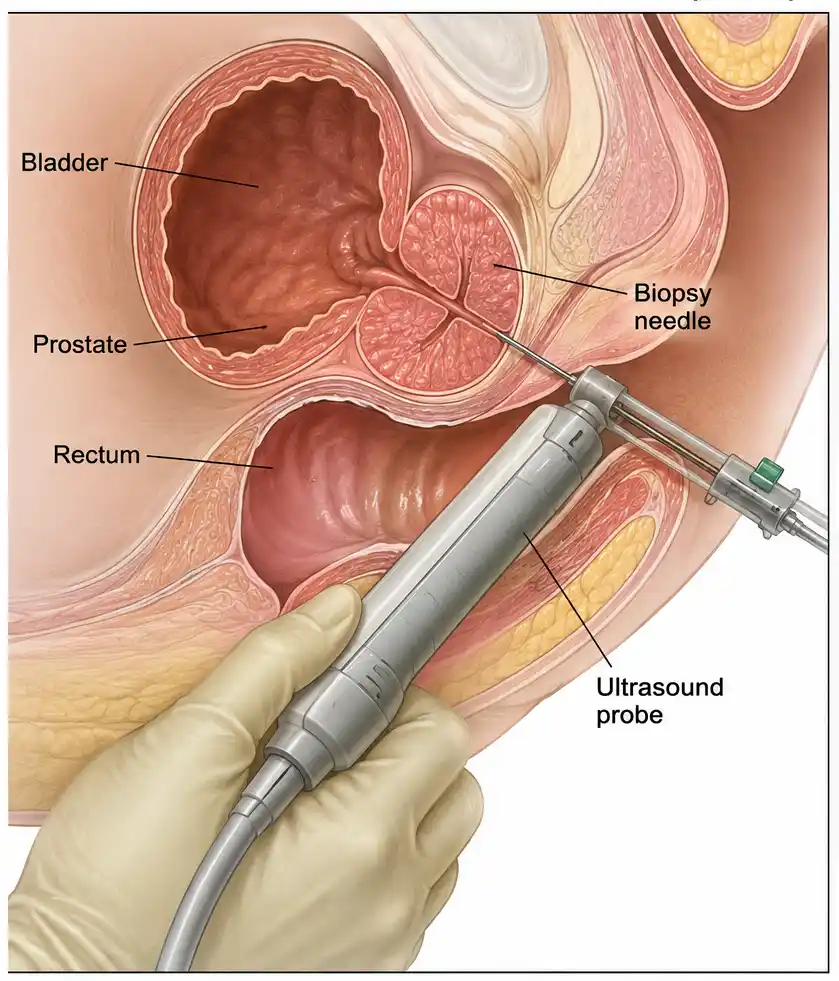
In this technique, a specialised ultrasound probe is inserted through the rectum to visualise the prostate gland. A fine biopsy needle is guided through the rectal wall to collect tissue samples from different areas of the prostate.
The procedure is generally performed under local anaesthesia to minimise discomfort.
2. Transperineal Prostate Biopsy
In this approach, tissue samples are collected through the skin between the scrotum and anus, known as the perineum. Ultrasound guidance helps the doctor identify the targeted areas of the prostate.
This technique can reduce the risk of infection associated with the transrectal route and is increasingly used for prostate cancer diagnosis.
The doctor will recommend the most suitable approach after reviewing the patient’s reports and clinical condition.
How Is a Prostate Biopsy Performed?
A prostate biopsy is generally a minimally invasive day-care procedure. At Jewel Urology Center, the diagnostic approach is planned according to the patient’s individual requirements.
The procedure typically involves the following steps:
Step 1: Patient Positioning
The patient is positioned appropriately to allow the doctor to access and examine the prostate gland. The position may vary depending on the biopsy technique.
Step 2: Ultrasound Examination
An ultrasound probe is used to visualise the prostate and guide the biopsy needle. This helps the specialist identify the appropriate areas for tissue sampling.
Step 3: Local Anaesthesia
Local anaesthesia is administered to reduce discomfort during the procedure. Additional anaesthesia or sedation may be considered depending on the technique and patient requirements.
Step 4: Collection of Tissue Samples
A specialised biopsy needle collects small tissue samples from different regions of the prostate. Usually, approximately 12–15 samples are obtained during a systematic biopsy. Additional targeted samples may be collected when MRI identifies suspicious lesions.
Step 5: Post-Procedure Observation
After the procedure, the patient is monitored briefly to ensure there are no immediate complications. Most patients can return home on the same day, depending on their clinical condition.
The procedure generally takes around 15–30 minutes, although the duration can vary.
How Does MRI Improve Prostate Biopsy Accuracy?
Multiparametric MRI has significantly improved the evaluation of suspected prostate cancer. It provides detailed images of the prostate and helps identify areas that may contain clinically significant cancer.
MRI findings can guide doctors towards suspicious lesions rather than relying exclusively on random tissue sampling.
Some important advantages include:
- Better identification of suspicious prostate lesions.
- Improved targeting of abnormal areas.
- Increased detection of clinically significant cancers.
- Better assessment of prostate anatomy.
- More informed biopsy planning.
MRI-targeted biopsy may be performed using MRI-ultrasound fusion technology or other image-guided techniques, depending on the available equipment and clinical requirements.
Combining MRI findings with PSA levels and clinical examination helps specialists develop a more comprehensive diagnostic plan.
Preparation and Recovery After a Prostate Biopsy
Proper preparation is important for reducing complications and ensuring a smooth procedure.
Before undergoing a biopsy, your doctor may recommend:
- Blood tests to evaluate bleeding risk.
- Urine testing to check for infection.
- Reviewing all current medications, particularly blood thinners.
- Adjusting certain medicines only under medical supervision.
- Antibiotics when indicated by the biopsy technique and individual infection risk.
- Informing the doctor about allergies and existing medical conditions.
After the procedure, patients may experience mild soreness, temporary urinary symptoms or small amounts of blood in the urine, stool or semen. These effects are generally temporary.
Following your doctor’s instructions can support recovery. Patients are usually advised to avoid strenuous physical activities for a short period.
Seek immediate medical attention if you experience:
- Fever or chills.
- Difficulty passing urine.
- Heavy or persistent bleeding.
- Blood clots in the urine.
- Severe or increasing pain.
These symptoms may indicate complications requiring prompt medical evaluation.
What Do Prostate Biopsy Results Reveal?
The collected tissue samples are examined by a pathologist to identify abnormal or cancerous cells.
If cancer is detected, the pathology report may include the Gleason score and Grade Group, which help doctors understand the aggressiveness of the cancer.
The results help determine whether the patient may benefit from:
- Active surveillance: Regular monitoring for selected low-risk prostate cancers.
- Radiation therapy: Treatment using targeted radiation to destroy cancer cells.
- Robotic prostatectomy: Surgical removal of the prostate in suitable patients.
- Hormonal therapy: Treatment that reduces the effects of male hormones on prostate cancer cells.
- Additional investigations: Further scans or tests when required to understand disease extent.
A biopsy result showing cancer does not automatically mean immediate surgery is necessary. Treatment decisions depend on cancer grade, stage, PSA levels, age and overall health.
Why Choose Dr. Vivek Venkat for Prostate Biopsy in Mumbai?
Choosing an experienced urologist is important when undergoing diagnostic procedures for suspected prostate cancer.
Dr. Vivek Venkat is a fellowship-trained Uro-Oncologist and Robotic Surgeon with advanced training from the University of Miami Miller School of Medicine, USA.
His qualifications and professional experience include:
- MBBS: B.J. Medical College, Pune.
- MS in General Surgery: Seth G.S. Medical College and K.E.M. Hospital, Mumbai.
- MCh in Urology: Christian Medical College (CMC), Vellore, where he received a gold medal.
- International Fellowship: Urologic Oncology and Robotic Surgery at the University of Miami Miller School of Medicine, USA (2015–2017).
- ECFMG Certification: United States.
He previously served as Assistant Professor of Urology and Renal Transplantation at CMC Vellore and Clinical Instructor in Urologic Oncology and Robotic Surgery at the University of Miami Hospital.
Dr. Vivek Venkat has participated in more than 800 robotic surgical cases and has contributed to research published in The Lancet, including the landmark RAZOR trial on bladder cancer surgery. His areas of expertise include prostate cancer screening and biopsy, MRI-based evaluation, robotic prostatectomy, kidney cancer and bladder cancer management.
Patient-Centred Care at Jewel Urology Center
Jewel Urology Center in Vile Parle West, Mumbai, provides access to specialised urological consultations and diagnostic guidance.
Dr. Vivek Venkat follows an evidence-based approach, focusing on understanding each patient’s medical history, evaluating investigation reports and discussing suitable diagnostic and treatment options.
Patients benefit from personalised consultations, clear explanations of procedures and guidance throughout their diagnostic journey. Dr. Vivek Venkat also consults at Nanavati Max Super Speciality Hospital and offers video consultations for patients who cannot travel to Mumbai.
For individuals looking for the Best Uro Surgeon in Mumbai, Dr. Vivek Venkat brings together international fellowship training, uro-oncology expertise and experience in advanced robotic urological procedures.
Frequently Asked Questions (FAQs)
1. Is a prostate biopsy painful?
A prostate biopsy is generally well tolerated. Local anaesthesia is used to minimise discomfort during tissue sampling. Some patients may experience mild soreness or temporary discomfort after the procedure, which usually improves within a few days.
2. How long does it take to recover after a prostate biopsy?
Most patients return home on the same day and resume routine activities within 2–3 days, depending on their recovery and the biopsy technique. Strenuous activities should be avoided for the period recommended by the treating doctor.
3. Does an elevated PSA level always mean prostate cancer?
No. Elevated PSA levels can occur due to prostate enlargement, inflammation, infection and prostate cancer. A doctor may recommend additional investigations, including MRI and biopsy, to establish an accurate diagnosis.
4. What happens if a prostate biopsy confirms cancer?
If cancer is detected, the doctor evaluates the Gleason score, Grade Group, PSA level, MRI findings and cancer stage. Depending on the risk category, treatment may include active surveillance, radiation therapy, hormonal treatment or robotic prostate surgery.
Book Your Consultation with Dr. Vivek Venkat
Early and accurate diagnosis plays an important role in effective prostate cancer management. If you have elevated PSA levels, suspicious MRI findings or a family history of prostate cancer, consulting an experienced uro-oncologist can help you understand your risk and available diagnostic options.
At Jewel Urology Center, Dr. Vivek Venkat provides specialised prostate cancer evaluation, biopsy guidance and personalised treatment planning. His international fellowship training and experience in uro-oncology and robotic surgery support a comprehensive approach to prostate health.
If you are considering Prostate biopsy in Mumbai, schedule a consultation with Dr. Vivek Venkat to discuss your reports, understand the procedure and receive appropriate medical guidance.
Contact Details:
📞+91 9136041545
📧appointments@drvivekvenkat.com
📍Get Directions to the Clinic – Jewel Urology Center
Book your appointment with Dr. Vivek Venkat today for expert prostate evaluation and personalised urological care.