
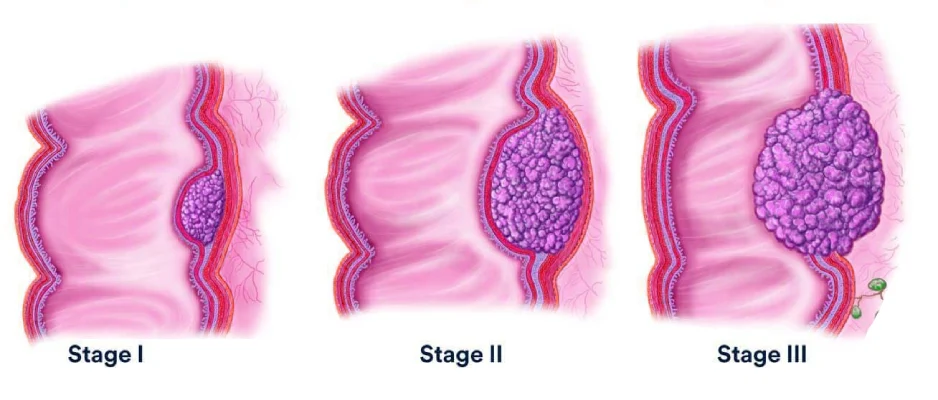
A diagnosis of stage 3 colon cancer can be overwhelming for patients and their families, but it is important to understand that Stage 3 colorectal cancer is treatable and, in many cases, potentially curable with appropriate and timely treatment. At this stage, the cancer has generally spread from the colon to nearby lymph nodes or surrounding tissues but has not spread to distant organs. Treatment typically involves a combination of surgery and chemotherapy, with the exact plan depending on the location and characteristics of the tumour, lymph-node involvement, and the patient’s overall health.
Dr. Chintamani Godbole is a Consultant Colorectal Surgeon with a special interest in colorectal cancer and peritoneal surface oncology. He has advanced training in robotic and minimally invasive colorectal surgery and provides colorectal cancer care in Mumbai.
What Is Stage 3 Colon Cancer?
Colorectal cancer is commonly classified into four stages. In the earlier stages, the cancer remains confined to the intestinal wall. In Stage 3, cancer cells have spread to nearby lymph nodes or tissues around the primary tumour, but there is no evidence of distant spread to organs such as the liver or lungs. Stage 4 colorectal cancer, by comparison, involves distant metastatic disease.
The exact extent of Stage 3 disease can vary considerably between patients. The number of affected lymph nodes, depth of tumour invasion, tumour characteristics, and other pathological findings can influence treatment decisions and prognosis.
For this reason, patients should not assume that everyone with Stage 3 disease requires exactly the same treatment.
Symptoms of Stage 3 Colon Cancer
Symptoms of colon cancer can vary depending on the tumour’s location and extent. Some patients may have symptoms for several months, while others may be diagnosed following an investigation for a different concern.
Possible symptoms include:
- Blood in the stool
- Persistent changes in bowel habits
- Constipation or diarrhoea
- A feeling that the bowel has not completely emptied
- Abdominal pain or cramping
- Unexplained weight loss
- Persistent fatigue or weakness
- Anaemia
- Reduced appetite
- Bloating or abdominal discomfort
These symptoms do not necessarily mean that a person has colon cancer. Several gastrointestinal conditions can cause similar symptoms. However, persistent or unexplained changes should be evaluated by a qualified doctor.
How Is Stage 3 Colon Cancer Diagnosed?
Accurate diagnosis and staging are essential for developing an appropriate treatment plan.
A typical diagnostic work-up may include:
Colonoscopy and Biopsy
A colonoscopy allows the doctor to examine the inside of the colon and identify abnormal growths or polyps. A biopsy can then be performed to confirm whether abnormal tissue contains cancer cells.
CT or PET-CT
Imaging of the chest, abdomen, and pelvis may be used to assess the extent of disease and determine whether there is evidence of spread beyond the local region.
Pathological Examination
If surgery is performed, the removed tumour and surrounding lymph nodes are examined by a pathologist. This provides important information about the tumour and lymph-node involvement.
For rectal cancer, an MRI of the pelvis is also an important part of local staging.
Treatment for Stage 3 Colon Cancer
Treatment for Stage 3 colorectal cancer generally requires a multidisciplinary approach. Surgery and chemotherapy are central components for many patients with Stage 3 colon cancer, while treatment for rectal cancer may additionally involve radiation or chemoradiation depending on the tumour’s location and characteristics.
Surgery for Colon Cancer
For colon cancer, surgery generally involves removing the section of the colon containing the tumour along with surrounding tissue and nearby lymph nodes. This procedure is known as a colectomy.
The goal is to remove the cancer with an appropriate margin and assess the lymph nodes to establish the pathological stage.
Dr. Godbole’s expertise includes robotic and laparoscopic surgery for colon and rectal cancer. His profile also describes experience with minimally invasive colorectal surgery and sphincter-preserving procedures for selected rectal cancers.
Chemotherapy
Chemotherapy is commonly recommended after surgery for many patients with Stage 3 colon cancer. Its purpose is to treat microscopic cancer cells that may remain in the body after the primary tumour has been removed.
The duration and specific medicines depend on the patient’s pathology, overall health, tumour characteristics, and the treating oncology team’s recommendations. Dr. Godbole’s published colon-cancer information notes that most Stage 3 colorectal cancer patients require chemotherapy after surgery, although treatment decisions also depend on individual fitness and clinical factors.
Treatment for Stage 3 Rectal Cancer
Rectal cancer requires a somewhat different treatment strategy because of its location within the pelvis. Radiation therapy or chemoradiation may be recommended before surgery in appropriate cases to reduce tumour size and improve local control.
Surgery is then performed to remove the tumour. Depending on the tumour’s location and response to treatment, surgeons may be able to preserve the anal sphincter in selected patients.
Can Stage 3 Colon Cancer Be Cured?
Stage 3 colorectal cancer is not synonymous with incurable disease. Dr. Godbole’s published information states that, with appropriate multimodality treatment, around 70% of colorectal cancers can be cured. However, this figure should not be interpreted as an individual prediction.
An individual’s outlook depends on several factors, including:
- Exact tumour stage
- Number of lymph nodes involved
- Tumour biology
- Response to treatment
- Surgical results
- General health and fitness
- Ability to complete recommended treatment
- Other medical conditions
Your treating cancer team can provide a more individualized discussion after reviewing pathology and imaging results.
Is a Colostomy Always Necessary?
A common concern after a colorectal cancer diagnosis is whether surgery will result in a permanent stoma.
A colostomy is not automatically required for every patient with Stage 3 colon cancer. Depending on the location of the tumour and the type of operation, the bowel may be reconnected after the diseased segment is removed.
In some rectal cancer operations, a temporary ileostomy may be created to protect the bowel connection while it heals. Dr. Godbole’s published information notes that temporary stomas can sometimes be reversed after treatment, while only selected low rectal cancers may require a permanent colostomy.
Life After Stage 3 Colon Cancer Treatment
The aim of treatment extends beyond removing cancer. Maintaining quality of life and helping patients return to normal activities are important parts of colorectal cancer care.
After treatment, patients may gradually return to:
- A normal diet
- Work and daily activities
- Exercise
- Social activities
- Family life
Bowel habits can change after colorectal surgery, particularly during the early recovery period. Diet, medication, physical activity, and follow-up care can help patients adapt as recovery progresses.
Dr. Godbole’s colon-cancer information also describes an Enhanced Recovery After Surgery approach, including early mobilisation and nutritional support after appropriate bowel surgery.
Follow-Up After Treatment
Completing surgery and chemotherapy does not mean that follow-up can be stopped. Regular surveillance is important to monitor recovery and identify possible recurrence early.
Depending on the individual treatment plan, follow-up can include tumour-marker testing such as CEA, imaging, and colonoscopy. The frequency of these investigations varies according to the patient’s cancer characteristics and the recommendations of the treating team. Dr. Godbole’s published Stage 3 colorectal cancer information provides a structured surveillance schedule while noting that follow-up should be tailored to the patient.
Why Choose Dr. Chintamani Godbole?
Dr. Chintamani Godbole is a super-specialist colorectal surgeon with qualifications including MBBS, MS in General Surgery, DNB in Surgical Gastroenterology, and FRCS from Edinburgh. He completed his initial surgical training at Seth G. S. Medical College and KEM Hospital, Mumbai, followed by super-specialty training in gastrointestinal surgery at Jaslok Hospital and Research Centre.
He subsequently spent five years in the United Kingdom, undertaking fellowships in minimally invasive colorectal surgery, robotic and laparoscopic surgery, colorectal cancer surgery, peritoneal cytoreductive surgery, and HIPEC. He also trained at the Basingstoke Peritoneal Malignancy Institute and worked as a General/Colorectal Surgical Consultant at University Hospitals Coventry in the UK.
His current profile reports experience with more than 200 minimally invasive colorectal surgeries and more than 50 cytoreductive surgeries with HIPEC for advanced peritoneal cancers. His areas of expertise include robotic and laparoscopic colorectal cancer surgery, sphincter-preserving rectal surgery, and treatment of inflammatory bowel disease.
Patients looking for a Colorectal Surgeon in Mumbai can consult Dr. Godbole for evaluation of colon and rectal cancers and discussion of appropriate treatment options.
A Multidisciplinary Approach to Cancer Care
Colorectal cancer treatment often involves more than one specialist. Depending on the diagnosis, patients may need a colorectal or GI cancer surgeon, medical oncologist, and radiation oncologist.
Dr. Godbole’s published Stage 3 cancer guidance emphasizes shared decision-making between the patient, surgeon, and oncology team. This multidisciplinary approach allows the treatment plan to consider surgery, chemotherapy, radiation where appropriate, and the patient’s overall health together.
Patients searching online at Gadre Hospital for the Best Doctor for Gastroenterology in Mumbai should consider relevant qualifications, specialized colorectal training, experience with the particular cancer, and access to multidisciplinary cancer care when choosing a specialist.
Book a Consultation at Gadre Hospital
A Stage 3 colorectal cancer diagnosis requires timely evaluation and coordinated treatment. If you or a family member has recently been diagnosed, discussing the pathology, scans, and available treatment options with a colorectal cancer specialist can help clarify the next steps.
📞 Call: 81087 91470
📧 Email: drchintamanigodbole@gmail.com
Get Directions to Gadre Hospital
Consult Dr. Chintamani Godbole at Gadre Hospital for a detailed evaluation of colon or rectal cancer. Bring your colonoscopy and biopsy reports, CT/PET-CT or MRI scans, blood-test reports, and previous treatment records so that the medical team can review your case and discuss the appropriate treatment pathway.
Frequently Asked Questions
1. What does Stage 3 colon cancer mean?
Stage 3 colon cancer generally means that the cancer has spread to nearby lymph nodes or surrounding tissues but has not spread to distant organs. The exact extent varies between patients and is determined through imaging and pathological examination.
2. Is chemotherapy required for Stage 3 colon cancer?
Many patients with Stage 3 colon cancer receive chemotherapy after surgery. The specific chemotherapy plan depends on the cancer’s pathological features, the patient’s overall health, and the recommendations of the multidisciplinary cancer team.
3. Can Stage 3 colon cancer be cured?
Stage 3 colorectal cancer can be curable in many patients when appropriately treated. However, an individual’s prognosis depends on tumour characteristics, lymph-node involvement, treatment response, overall health, and other factors. Published information from Dr. Godbole’s site reports that around 70% of colorectal cancers can be cured with appropriate multimodality treatment, but this is not a prediction for an individual patient.
4. Will I need a permanent colostomy after colon cancer surgery?
Not necessarily. Whether a stoma is required depends on the tumour’s location, the type of surgery, and individual clinical circumstances. Some patients may have a temporary stoma, particularly after certain rectal cancer operations, while selected low rectal cancers may require a permanent colostomy.