
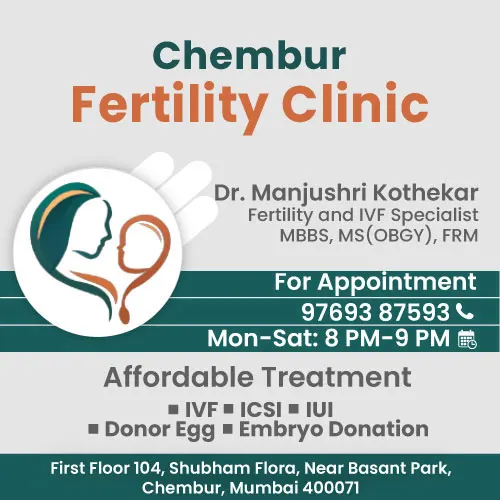
Choosing the right fertility centre can be an important decision for couples exploring assisted reproductive treatment. An IVF clinic in Mumbai Chembur can provide access to fertility evaluation, assisted conception options and ongoing monitoring under specialist care. At Chembur Fertility Clinic, Dr. Manjushri Kothekar provides fertility consultations and sonography, while IVF and other assisted reproductive treatments are conducted at affiliated ART centres. The clinic’s approach includes personalised treatment planning, counselling and support throughout the fertility journey.
What Is IVF and When Is It Considered?
In vitro fertilisation (IVF) is an assisted reproductive technique in which eggs and sperm are combined outside the body in a laboratory. Once fertilisation occurs and embryos develop, an embryo may be transferred into the uterus.
IVF may be considered for different infertility situations, including advanced maternal age, damaged or blocked fallopian tubes, certain male-factor fertility problems and previous unsuccessful fertility treatments. The appropriate treatment depends on individual fertility investigations and the medical history of both partners.
IVF is not necessarily the first treatment for every couple. Depending on the diagnosis, options such as ovulation treatment or intrauterine insemination (IUI) may be considered before IVF.
IVF clinic in Mumbai Chembur: Treatment Process
The IVF process involves several stages, and the exact protocol can vary depending on ovarian reserve, age, previous treatment and other clinical factors.
1. Suppression of the Natural Cycle
In some IVF protocols, medication is used to suppress the natural menstrual cycle. This helps the fertility team coordinate subsequent stimulation and treatment.
2. Ovarian Stimulation
Fertility hormones, including follicle-stimulating hormone (FSH), may be prescribed to stimulate the ovaries to develop multiple follicles. The objective is to obtain several mature eggs rather than relying on a single naturally ovulated egg.
3. Monitoring
During stimulation, follicular development is monitored through vaginal ultrasound examinations and blood tests. Medication may be adjusted according to the patient’s response. A trigger injection, such as hCG, may be used to support final egg maturation when appropriate.
4. Egg Retrieval
Egg collection is performed as a minor procedure under sedation. A needle is guided through the vagina to retrieve mature eggs from the ovaries. The clinic’s published information states that egg retrieval generally takes around 15–20 minutes.
5. Fertilisation and Embryo Development
The retrieved eggs are fertilised with sperm in a laboratory. When indicated, ICSI—intracytoplasmic sperm injection—may be used, where an individual sperm is injected directly into an egg.
The resulting embryos are monitored as they develop. Embryos may be cultured for up to approximately six days before transfer or cryopreservation, depending on the treatment plan.
6. Embryo Transfer
Embryo transfer involves placing a selected embryo into the uterus using a thin catheter. Compared with egg retrieval, this is generally a simpler procedure and usually does not require sedation.
After transfer, follow-up is arranged and a pregnancy test is generally performed after the appropriate waiting period.
Fertility Services Beyond IVF
A comprehensive fertility evaluation may identify situations where IVF is not the only available option. Chembur Fertility Clinic lists several reproductive services, including IUI, IVF and ICSI, donor egg testing, PGT testing, donor sperm treatment and embryo donation or adoption.
The selection of treatment should be based on the diagnosis, age, ovarian reserve, sperm parameters, previous fertility history and other relevant medical factors.
Dr. Manjushri Kothekar: Qualifications and Experience
Dr. Manjushri Kothekar holds an MBBS, MS in Obstetrics & Gynaecology, and a Fellowship in IVF and Reproductive Medicine. Her fellowship training in reproductive medicine was completed at NOVA IVI Fertility.
According to her professional profile, Dr. Manjushri Kothekar has more than 12 years of experience in Obstetrics and Gynaecology, including approximately nine years focused exclusively on IVF and infertility. Her professional experience includes work with fertility centres such as Currae IVF, Cocoon Fertility and NOVA IVI Fertility.
Her clinical experience includes managing complex infertility cases and complications associated with assisted reproduction. She has also undertaken specialised training in ICSI, laparoscopic procedures and endoscopic skills. Her academic contributions include research publications in international journals and chapters in medical publications.
For patients researching a Top IVF Doctor in Mumbai, qualifications, fertility-specific experience and familiarity with advanced reproductive techniques can be important considerations.
Personalised Fertility Care at Chembur Fertility Clinic
The clinic’s published approach places emphasis on personalised treatment plans, advanced reproductive techniques, patient safety, single-embryo transfer when appropriate and comprehensive support. Counselling and fertility support are also described as part of the patient journey.
The Chembur clinic is located at First Floor 104, Shubham Flora, Near Basant Park, Chembur, Mumbai – 400071. Importantly, the clinic states that it is used for consultations and sonography, while treatments are conducted at affiliated ART centres. Patients should therefore clarify where each stage of their planned treatment will take place during consultation.
Patients searching for a Best IVF specialist in Mumbai may benefit from considering not only the clinic location but also the doctor’s fertility training, laboratory and ART-centre facilities, treatment protocols, counselling support and approach to individualised care.
Understanding IVF Success and Risks
IVF can offer an important treatment option for infertility, but pregnancy is not guaranteed. Outcomes can be influenced by factors such as age, ovarian reserve, embryo quality, sperm factors, underlying medical conditions and previous treatment history.
The clinic highlights potential risks associated with IVF, including ovarian hyperstimulation syndrome (OHSS), multiple pregnancy, ectopic pregnancy and pregnancy-related complications. Careful monitoring and an appropriately selected embryo-transfer strategy can help manage certain risks.
Patients should discuss their individual probability of success and potential complications with their fertility specialist rather than relying on general success-rate figures.
How Long Does IVF Treatment Take?
The duration of an IVF cycle varies. It can involve initial consultations and fertility investigations followed by ovarian stimulation, monitoring, egg retrieval, fertilisation, embryo development, transfer and follow-up.
The clinic states that the overall process can range from several weeks to a few months depending on individual circumstances and treatment requirements.
The waiting period after embryo transfer can also be emotionally challenging. Appropriate counselling and communication with the fertility team can help patients understand what to expect during this stage.
Why a Detailed Consultation Matters
Fertility treatment should not follow a one-size-fits-all approach. Before starting IVF, the doctor may review the couple’s fertility history, previous treatments, investigations, ovarian reserve, sperm parameters and other factors that could influence treatment selection.
A detailed consultation also gives patients an opportunity to ask about medication, monitoring, egg retrieval, fertilisation methods, embryo transfer, possible additional procedures and the expected timeline.
FAQs
1. Is IVF suitable for every couple experiencing infertility?
No. IVF is one of several fertility treatments. Depending on the underlying cause of infertility, age and previous treatment history, a doctor may recommend IUI, medication, surgery or another approach instead of or before IVF.
2. How long does an IVF cycle take?
The timeline varies between patients and treatment protocols. It may take several weeks and, in some circumstances, longer when additional testing, embryo freezing or staged treatment is required.
3. What is the difference between IVF and ICSI?
In conventional IVF, eggs and sperm are combined in a laboratory to allow fertilisation. With ICSI, a single sperm is directly injected into an egg. ICSI may be recommended in selected cases based on the couple’s fertility assessment.
4. Where is IVF treatment performed after consultation at Chembur Fertility Clinic?
The clinic states that its Chembur location is primarily for consultations and sonography, while treatments are conducted at affiliated ART centres. Patients should confirm the treatment location and arrangements during their consultation.
Consult Dr. Manjushri Kothekar
If you are considering an IVF clinic in Mumbai Chembur, Dr. Manjushri Kothekar can assess your fertility history and discuss appropriate assisted-reproduction options based on your individual circumstances.
📞 +91 9769387593
📧 manjuamolkothekar@gmail.com
Get directions to the clinic – Chembur Fertility Clinic